Comment
Rail can have its ‘Uber Moment’ – but only if passenger experience leads the way
Rebecca Crook, CEO at MSQ DX, argues that GPS tracking and automatic pricing in rail ticketing could remove the same friction points that made traditional taxis feel antiquated.
Main video supplied by CG Tan/Vetta / Getty Images Plus via Getty Images
The UK Department for Transport’s (DfT) announcement that new ticketing technology will be trialled across the Midlands and North is a huge moment for UK rail. The scheme trials a new way of rail ticketing, suggesting a future which does away from last-minute rushes at the ticket machine or struggling-to-load apps.
Instead, passengers are automatically charged the best fare at the end of the day’s travel – sparing the guesswork and rigidity of traditional ticketing. And with 500 people already signed up, there’s a clear appetite for change. But success won’t come from technology alone. The winners will be those who design every touchpoint around passenger needs – from sign-up to payment.
Rolling ahead with the times
It may not feel like it when you’re stuck waiting on your delayed train on a rainy platform, but transport problems are often information problems in disguise. The biggest source of frustration for passengers isn’t always the journey itself, but how confusing, inflexible or outdated the systems around it feel.

Rebecca Crook, CEO, MSQ DX
The disruption of traditional taxis proves a simple truth: when someone reimagines a broken experience, entire industries have to follow.
What was acceptable yesterday – cash-only payments, hoping to flag one down, no choice of driver – becomes yesterday's business model.
Yet rail continues to make passengers work for it – decode our fares, pick your ticket, hope you got it right.
The blueprint for change is clear: make payment invisible, pricing transparent, and earn trust with every journey.
Unlimited contactless payments and 'best price guaranteed' models do exactly this. They're not just conveniences, they're trust-builders. And trust is something rail urgently needs to restore.
From station platforms to data platforms
Rail already has the raw materials to begin implementing change, but it needs to use these correctly. Most companies have a trove of data on travel patterns, location data and ticket history that can enable ticketing apps digital systems to work intelligently in the background.
But businesses must use this info correctly and responsibly. And passive data collection must translate into active benefits that remove uncertainty, automate the admin, and help passengers feel the system is doing the heavy lifting.
This doesn’t mean inventing entirely new infrastructure but instead applying existing technology in a way that feels human and useful.
Don’t rip up the tracks
The rail industry doesn’t need to replace everything and start again to deliver a better passenger experience. What matters is making existing systems work harder for customers. Incremental improvements can be made. For example, layering new ticketing experiences on top of current infrastructure which can remove friction without the cost of upheaving the entire app.
Simplicity is important here. As Apple has shown, the best design is often the simplest. Rail’s digital platforms should require as little effort as possible from the user, reduce mental load, and quietly do the hard work in the background.
Smart transformation doesn't always have to mean replacing entire systems, it can unlock the value trapped inside them by redesigning the experience.
The power of certainty
This trial reveals an uncomfortable truth: uncertainty is a business killer. When passengers can't trust the fare system, they don't just choose a different ticket – they choose a different mode of transport entirely.
The inverse is equally powerful. Guarantee the best price, remove the guesswork, and watch hesitation turn into habitual use. This isn't a service upgrade, it's a commercial imperative. Every moment of fare anxiety is a lost customer, a missed journey, leaked revenue.
The technology exists. The appetite is proven. But here's what will separate winners from losers: the ability to translate these capabilities into experiences passengers actually trust. Get it right, and rail doesn't just catch up – it leaps ahead. Get it wrong, and watch another industry get "Ubered" while clutching its legacy systems.
The clock is ticking. Not because the technology is complex, but because passenger patience isn't infinite.
On The Ground International assists Venezuelan caminantes (pictured) between Pamplona and La Laguna, Santander, Colombia. Credit: On The Ground International / Facebook
The Smart Clinic in La Guajira, Colombia. Credit: Siemens Healthineers
Numb feet, bleeding legs and dehydrated bodies mark their journeys – not to mention infectious diseases and psychological trauma. Studies have identified outbreaks of measles, diphtheria and malaria across Venezuela, while tuberculosis, typhoid and HIV, are also resurgent.

Caption. Credit:

Once we see where those changes are, we can plan where we’re going to cut the bone.
Dr Lattanza
Total annual production
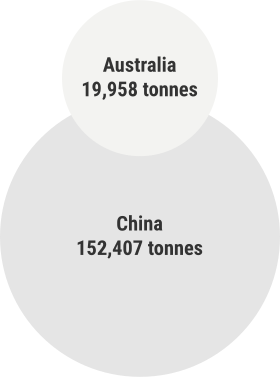
Australia could be one of the main beneficiaries of this dramatic increase in demand, where private companies and local governments alike are eager to expand the country’s nascent rare earths production. In 2021, Australia produced the fourth-most rare earths in the world. It’s total annual production of 19,958 tonnes remains significantly less than the mammoth 152,407 tonnes produced by China, but a dramatic improvement over the 1,995 tonnes produced domestically in 2011.
The dominance of China in the rare earths space has also encouraged other countries, notably the US, to look further afield for rare earth deposits to diversify their supply of the increasingly vital minerals. With the US eager to ringfence rare earth production within its allies as part of the Inflation Reduction Act, including potentially allowing the Department of Defense to invest in Australian rare earths, there could be an unexpected windfall for Australian rare earths producers.
